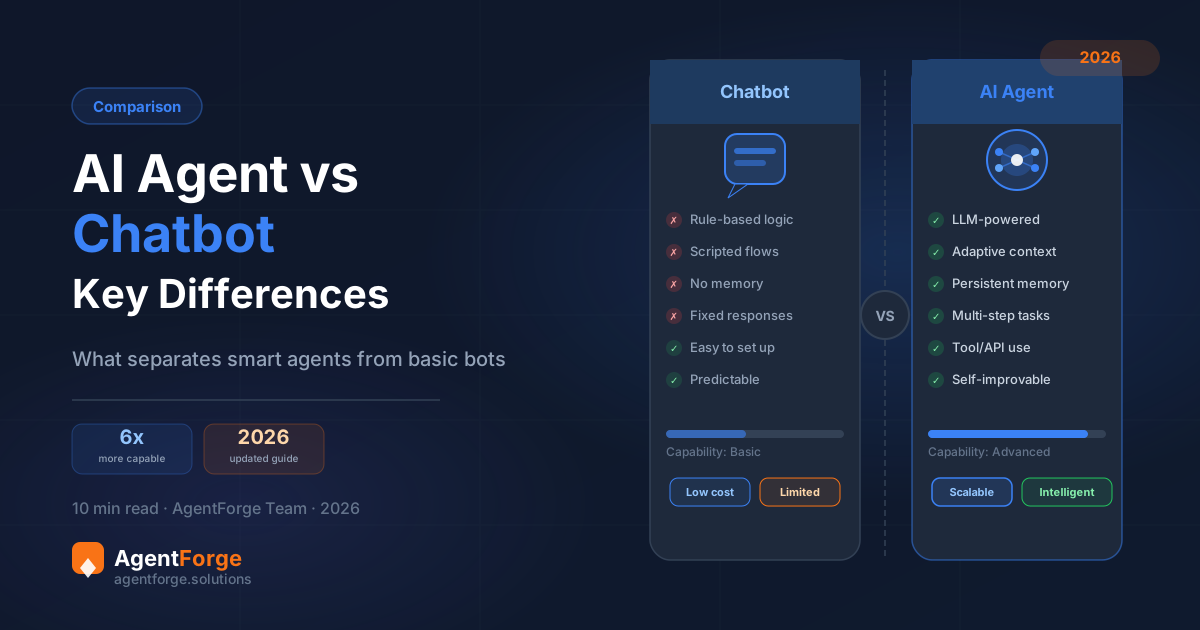
“AI agent” and “chatbot” are used interchangeably in most marketing materials, vendor pitches, and tech articles — which creates real problems when businesses try to make informed decisions about which technology to actually deploy. They are not the same thing. The differences are architectural, behavioral, and commercially significant.
According to Gartner, 40% of enterprise applications will include embedded AI agent capabilities by the end of 2026. Whether those agents deliver genuine value or merely replicate the limitations of the chatbots that came before them depends almost entirely on whether the teams deploying them understand what they’re actually building.
This guide cuts through the confusion with a precise, practical breakdown: what a chatbot is, what an AI agent is, seven concrete differences between them, and a decision framework for choosing the right approach for your business.
What Is a Chatbot?
A chatbot, in the traditional sense, is a rule-based conversational interface. It operates on decision trees: if the user says X, the bot does Y. This could be as simple as a button-based menu (“Press 1 for billing, press 2 for returns”) or as sophisticated as keyword detection with branching logic.
The defining characteristic of a traditional chatbot is that its behavior is entirely pre-defined by whoever built it. If a user’s query doesn’t match a programmed pattern, the chatbot fails — often with a generic fallback like “Sorry, I didn’t understand that. Please try rephrasing.”
Rule-based chatbots were the dominant technology from roughly 2015 to 2022. They powered Facebook Messenger bots, website pop-up chats, and IVR phone systems. They could handle narrow, predictable use cases efficiently, but broke down the moment a user deviated from the happy path. Their limitations were well-known:
- No ability to handle unexpected inputs — anything outside the decision tree returns an error
- No understanding of context — each message is processed independently, with no memory of prior turns
- No learning — the chatbot is identical on day 1,000 as it was on day 1 unless a human manually updates it
- No ability to take actions — it can display information but cannot execute tasks
- Significant maintenance burden — every new scenario requires explicit programming
A critical caution for 2026: “agent washing” has become a real phenomenon. Some vendors have taken their legacy rule-based chatbot platforms, added a thin LLM layer for FAQ responses, and rebranded the whole product as an “AI agent.” The platform is still fundamentally rule-based; the LLM is just used to rephrase scripted answers. When evaluating vendors, ask specifically how the system handles queries outside its trained scope, and whether it can execute multi-step tasks autonomously.
What Is an AI Agent?
An AI agent is an autonomous system that perceives its environment, reasons about goals, selects actions, and executes them — iterating through this loop until the goal is achieved or the situation requires human judgment. The “agent” metaphor is apt: like a human agent, it acts on your behalf with some degree of independence.
In practical terms for business deployment, an AI agent is characterized by four capabilities that separate it from a chatbot:
Language understanding at human level. Powered by large language models, AI agents understand the intent and context behind natural language — regardless of how it’s phrased, what language it’s in, or how many turns of conversation have preceded it.
Multi-step reasoning and task execution. An AI agent can plan and execute sequences of actions to achieve a goal. Asked “Can you book me a meeting with someone from the sales team for next week?”, it checks calendar availability, proposes slots, confirms the booking, and sends a confirmation — autonomously.
Tool use and system integration. AI agents connect to your CRM, calendar, order management system, database, and any API — using these tools to retrieve information and take actions that affect real business systems.
Memory and contextual awareness. An AI agent remembers the full conversation history and can reference prior turns. It also maintains persistent memory across sessions — knowing that this is the same customer who had a delivery issue last month, for example.
For a deeper technical explanation of how agentic AI architectures work, see our agentic AI explainer — including planning loops, tool use, and the difference between reactive and deliberative agents.
7 Key Differences: AI Agent vs Chatbot
Here are the seven dimensions that matter most for business decision-making, with concrete examples of how each plays out in practice.
| Dimension | Traditional Chatbot | AI Agent |
|---|---|---|
| Intelligence | Rule-based; keyword matching | LLM-powered; genuine reasoning |
| Flexibility | Breaks on unexpected inputs | Handles novel queries gracefully |
| Memory | Stateless; each message independent | Full context across conversation + sessions |
| Actions | Display info only | Executes tasks in connected systems |
| Integration | Standalone; siloed | Connected to CRM, calendar, APIs |
| Scalability | Fails on edge cases; high maintenance | Handles complexity; improves over time |
| Setup time | Weeks of flow-building | Hours with a no-code platform |
Let’s go deeper on each dimension with a concrete business example to illustrate why the difference matters.
1. Intelligence. A chatbot receives “What are your prices?” and matches it to a pricing intent that returns a templated response. An AI agent understands “I’m a freelancer with maybe 3 clients, is your Growth plan worth it for me?” — considering the question, interpreting the context, and giving a genuinely helpful comparison rather than a generic response.
2. Flexibility. A chatbot fails when a user deviates from the script. A user who mixes Spanish and English, or who asks a multi-part question, or who references something from two messages ago will often get a fallback response. An AI agent handles all of these naturally.
3. Memory. Chatbots are stateless — each message is processed without knowledge of what came before. AI agents maintain context through the entire conversation and can reference prior sessions. When a customer says “Like I mentioned before, I’m on the Growth plan”, the agent actually knows what was mentioned before.
4. Actions. This is the most commercially significant difference. A chatbot tells you “To book an appointment, call us at +39 02 1234567.” An AI agent asks for your preferred time, checks availability, books the slot, adds it to the calendar, and sends a confirmation — all within the conversation. The action is completed, not delegated.
5. Integration. A chatbot operates in isolation. An AI agent connects to your actual business systems: it can look up a customer’s order in your e-commerce platform, check their subscription status in your CRM, or update a support ticket in your helpdesk — in real time, during the conversation.
6. Scalability. A chatbot requires manual intervention every time a new edge case is discovered. An AI agent expands its capability as you add to its knowledge base. The ratio of maintenance effort to query-handling capacity is dramatically better.
7. Setup. Building a comprehensive decision-tree chatbot for a complex domain can take weeks of flow design. An AI agent configured on a no-code platform can be production-ready in hours — primarily because you’re providing information (your knowledge base), not programming behavior.
When to Use a Chatbot vs an AI Agent
Despite the advantages of AI agents, there are scenarios where a simpler chatbot is the right call.
Use a traditional chatbot when: your use case involves fewer than 10 predefined interactions, your queries are completely predictable, you have near-zero budget, and you genuinely cannot afford any incorrect responses (certain regulated contexts where AI responses must be exactly scripted). A button-based menu is sometimes the most reliable interface for very constrained workflows.
Use an AI agent when: your support queue involves more than 10 distinct query types, your customers ask questions in natural language with variable phrasing, you want the bot to actually execute tasks (not just display information), you operate across multiple channels, or you want to deploy once and maintain rarely rather than maintain constantly.
For most businesses in 2026, the cost of a capable AI agent platform has dropped to parity with traditional chatbot tools — making the “simple chatbot for budget reasons” argument largely obsolete. The better question is now: what should your AI agent focus on?
Building Your First AI Agent: The No-Code Path
The engineering barrier that once made AI agents the exclusive domain of well-funded tech teams has been eliminated by no-code platforms. On AgentForge’s AI agent builder, you configure your agent through a visual interface — no code, no API documentation to read, no deployment pipeline to manage.
The process is: define your agent’s personality and scope in the system prompt, upload your knowledge base, configure your escalation rules, connect your channels (website, WhatsApp, Telegram, Instagram), and go live. Most first-time users have a production-ready agent running in under four hours.
Build Your First AI Agent — Not Just Another Chatbot
AgentForge gives you LLM-powered agents with knowledge base training, multi-channel deployment, and real business tool integrations. No code required.
The Future: Chatbots Are Becoming Agents
The term “chatbot” is gradually becoming outdated as the underlying technology converges on agentic architectures. The next generation of customer-facing AI isn’t just more capable at conversation — it’s multi-agent: multiple specialized agents collaborating on complex tasks, handing off between each other based on expertise.
Voice AI is adding a new dimension — agents that speak and listen, not just type. Multimodal agents that process images, documents, and audio alongside text are already in production at leading companies. The trajectory is clear: the primitive chatbot of 2019 and the sophisticated AI agent of 2026 are not upgrades of the same system — they’re fundamentally different technology serving fundamentally different business goals.
Businesses that make the switch from rule-based chatbots to genuine AI agents typically report two outcomes simultaneously: higher customer satisfaction scores (because AI agents are actually helpful rather than frustrating) and lower support costs (because AI agents resolve a higher percentage of queries without human involvement). The productivity gain compounds over time as the knowledge base grows and the agent handles an ever-increasing share of the query volume.
For more context on deploying a WhatsApp AI chatbot specifically, see our WhatsApp AI chatbot for business guide. For a detailed cost breakdown across platforms, read the AI chatbot cost and pricing guide.
Frequently Asked Questions
Is ChatGPT a chatbot or an AI agent?
In its basic form, ChatGPT is a sophisticated conversational AI — closer to a chatbot than an agent. When configured with tools (code execution, browsing, API calls), it moves into agent territory. The distinction is whether the system can take actions in the real world, not just generate text responses.
Can a chatbot become an AI agent?
A traditional rule-based chatbot cannot become an AI agent without a fundamental architectural rebuild. Some platforms have added LLM layers to their chatbot infrastructure, which gives agent-like responses without true agentic capabilities. True agents require LLM-based reasoning, tool use, and persistent memory at the architectural level.
Are AI agents more expensive than chatbots?
Not meaningfully, in 2026. No-code AI agent platforms start at €25/month — comparable to or cheaper than many legacy chatbot platforms. The cost-per-query for AI agents is higher than rule-based systems, but the resolution rate is also dramatically higher, making the cost-per-resolution similar or better.
Do AI agents replace human support teams?
They handle the repetitive, high-volume tier of support — typically 60-80% of queries — freeing your human team for complex, high-value, emotionally nuanced interactions. The goal is augmentation, not replacement.
What’s the difference between an AI agent and a virtual assistant?
Consumer virtual assistants (Siri, Alexa, Google Assistant) are designed for individual, low-stakes tasks. Business AI agents are designed for enterprise workflows: they integrate with business systems, handle concurrent conversations at scale, and operate within defined business scope and escalation rules.
How long does it take to build an AI agent?
With a no-code platform like AgentForge, a basic agent can be live in under an hour. A production-ready agent with a comprehensive knowledge base, configured escalation, and multi-channel deployment typically takes 4–8 hours of setup time.
Can AI agents work on WhatsApp and Instagram?
Yes. Modern AI agent platforms support multi-channel deployment. One agent configuration runs simultaneously on web widget, WhatsApp, Instagram DMs, Telegram, and via API — consistent behavior across all channels.
Ready to Upgrade from Chatbot to AI Agent?
AgentForge builds AI agents — not rule-based chatbots. Start with a template and be live today.
Start for Free →