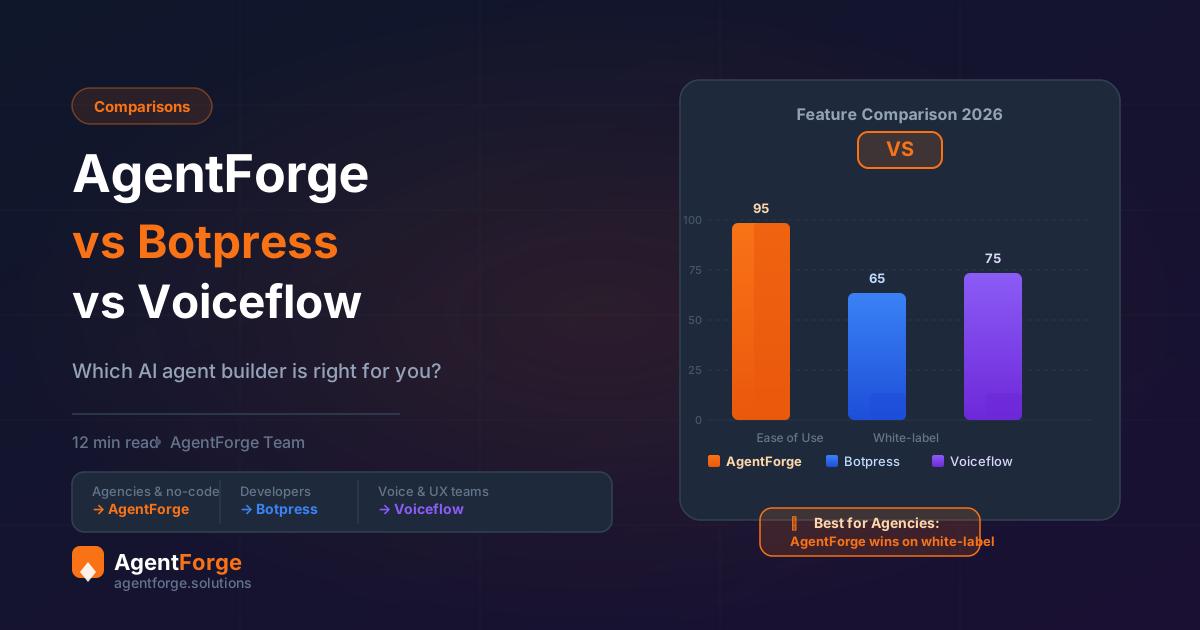
The AI agent builder market has changed beyond recognition in just a couple of years. What once required a full engineering team and months of work can now be done in an afternoon. Platforms like AgentForge, Botpress, and Voiceflow have made it possible for businesses of every size to deploy intelligent, conversational AI agents — but each platform makes very different trade-offs. Choosing the wrong one can cost you weeks of rework.
This guide is an honest, side-by-side comparison of three of the most talked-about platforms in 2026. We’ll look at pricing, ease of use, white-label capabilities, AI model flexibility, and the specific scenarios where each platform genuinely shines. By the end, you’ll have a clear picture of which tool belongs in your stack — and which ones you can safely ignore for your use case.
The AI Agent Builder Landscape in 2026
The market for AI agent builders has consolidated around a few distinct philosophies. Early tools were essentially rule-based chatbot builders with a conversational façade. Today, the leading platforms integrate large language models (LLMs) like Claude, GPT-5, and Gemini at their core, enabling genuinely intelligent, context-aware conversations. The result is that even a small business can now deploy an agent that feels indistinguishable from a human support rep in many situations. The hard part is no longer the AI — it’s choosing the right delivery vehicle.
Three distinct approaches have emerged as the dominant archetypes in 2026. First, the visual flow builder — pioneered by Voiceflow — which models conversations as flowcharts that non-technical designers can reason about visually. Second, the open-source/developer-first platform — best represented by Botpress — which gives engineers maximum control at the cost of a steeper setup curve. Third, the white-label, agency-focused SaaS — AgentForge’s niche — which prioritises fast deployment and multi-client management over raw customisability. Each approach is correct for a different buyer; the mistake is picking a philosophy that doesn’t match your team.
Quick Comparison — Feature Matrix
Before diving into each platform in depth, here is a high-level feature matrix. Use this as a quick sanity check, then read the detailed sections for the nuance that a table can’t capture.
| Feature | AgentForge | Botpress | Voiceflow |
|---|---|---|---|
| Pricing | From €25/mo | Free tier + paid | ~$50/mo+ |
| Free Tier | 50 trial credits | Yes | Yes (limited) |
| No-Code Builder | Yes | Partial (visual flow) | Yes (visual flow) |
| White-Label | Yes (from Scale) | Enterprise only | Enterprise only |
| Multi-Model AI | Yes (Claude, GPT, Gemini, Llama) | Yes | Limited |
| Knowledge Base | Yes | Yes | Yes |
| Live Chat Handoff | Yes | Yes | Yes |
| Webhooks / API | Yes | Yes | Yes |
| Open Source | No | Yes (core) | No |
| Best For | Agencies & non-technical teams | Developers & technical teams | Conversation designers & enterprise |
AgentForge — Best For Agencies and Non-Technical Users
AgentForge launched with a clear thesis: building and deploying an AI agent should not require a developer. It is a fully managed SaaS platform that handles hosting, scaling, and model access so that business owners, marketers, and digital agencies can focus entirely on the agent’s behaviour and content. If you have ever been frustrated by how much engineering overhead other platforms demand before you can show anything to a client, AgentForge was built specifically to remove that friction.
What AgentForge Does Well
The most immediate advantage is zero-code setup. You configure your agent through a guided builder — system prompt, knowledge base, conversation flow, structured data — without writing a single line of code. Most users report having a functional, widget-embedded agent ready to test in under ten minutes. That speed matters enormously when you are pitching to a client or validating an idea.
Multi-model AI is a genuine differentiator. Depending on your plan, you can choose from Claude (Haiku, Sonnet, Opus), GPT-5 variants, Gemini, and Llama models — all through the same interface. Each model has a credit cost attached, so you can optimise for capability or cost per conversation. This flexibility is rare at the non-enterprise tier.
The white-label offering is one of AgentForge’s clearest competitive advantages. While both Botpress and Voiceflow gate white-labelling behind expensive enterprise plans, AgentForge makes it accessible on the Scale plan. For a digital agency that wants to resell AI agents under its own brand, this is a significant cost saving. There is also a sub-account system for managing multiple client deployments from a single dashboard without mixing data or billing.
The platform also supports outbound webhooks, inbound API triggers, and structured data fields (business hours, pricing tables, FAQ, contact details, locations) that are automatically injected into the agent’s context. This means the agent stays accurate without manual prompt engineering every time something changes. You can read more about building your first agent in our guide to no-code AI agent creation.
Where AgentForge Falls Short
Honesty requires acknowledging the gaps. AgentForge is a younger product than either Botpress or Voiceflow, and it shows in a few areas. The community is smaller — there are fewer third-party tutorials, fewer Stack Overflow answers, and fewer pre-built integrations compared to the Botpress ecosystem. If you get stuck on something unusual, you are more likely to be relying on official support rather than community resources.
There is no open-source version. If self-hosting is a hard requirement — for data residency, compliance, or cost reasons at scale — AgentForge is not the right tool. The platform is fully managed and cloud-hosted. Similarly, the visual conversation flow tooling is less sophisticated than Voiceflow’s. If your use case genuinely requires branching multi-step conversation logic that you want to map visually, you may find AgentForge’s flow builder limiting.
Who Should Choose AgentForge
AgentForge is the right call if you are a digital agency managing multiple clients who want white-label AI agents without paying enterprise rates. It is also well-suited to non-technical entrepreneurs and small business owners who need a working agent fast and do not have the time or inclination to learn a developer-oriented tool. If white-label, multi-model flexibility, and speed-to-deploy are your top criteria, AgentForge is hard to beat at its price point. See our dedicated guide to white-label AI agents for agencies for a deeper look at this use case.
Botpress — Best For Developers Who Want Full Control
Botpress occupies a fundamentally different position in the market. It started as an open-source bot framework and has evolved into a commercial platform that retains its developer-first DNA. The core product is available on GitHub, and the self-hosted version gives you complete control over where your data lives. For teams that need to move fast but refuse to compromise on control, Botpress is often the answer. You can read a deeper breakdown in our AgentForge vs Botpress comparison.
What Botpress Does Well
The open-source core is the headline feature. You can clone the repository, run Botpress on your own infrastructure, and have full visibility into everything the platform does. This is non-negotiable for certain regulated industries (healthcare, finance) where data cannot leave your own environment. The self-hosted option also means you can scale without per-message pricing becoming a concern at very high volumes.
Advanced conditional logic and custom code execution within flows is where Botpress really separates itself from no-code alternatives. Developers can write JavaScript directly inside flow nodes, call external APIs mid-conversation, and build arbitrarily complex logic trees. If your agent needs to query a CRM, check inventory in real-time, or route conversations based on business rules that change frequently, Botpress gives you the primitives to do it properly.
The integrations ecosystem is mature. Botpress has first-party integrations with Slack, WhatsApp, Messenger, Telegram, and more, plus a plugin marketplace with community-contributed modules. The community itself is large and active, which means answers to common problems are easy to find. Developer tooling — CLI, local development server, version control — is polished and aligns with how software engineering teams already work.
Where Botpress Falls Short
The learning curve is steep for anyone who is not a developer. Botpress was designed by engineers, for engineers, and that shows in the UX. Non-technical users frequently report feeling lost, and even technically confident users need to invest real time in understanding the platform’s concepts before they can be productive. This is not a criticism — it is a trade-off — but it is the wrong tool if your team does not have engineering capacity to spare.
White-label capabilities are locked behind Enterprise pricing, which is a significant barrier for agencies or resellers who are not operating at enterprise scale. The commercial hosted plans are also structured around message volume in a way that can become expensive as you scale client deployments. Finally, for genuinely simple chatbot use cases, Botpress can feel like significant overkill — the flexibility is wonderful when you need it, but adds friction when you do not.
Who Should Choose Botpress
Botpress is the right choice for developers and engineering teams who want maximum control, the option to self-host, and the ability to write custom logic without fighting the platform. It suits complex use cases — multi-department routing, deep CRM integration, compliance-sensitive environments — where a no-code tool would hit its ceiling quickly. If your team can absorb the setup cost and values open-source principles, Botpress will serve you well.
Voiceflow — Best For Conversation Designers
Voiceflow started life as a builder for Alexa skills and Google Actions, and that heritage still shapes the product today. It is the most visually sophisticated of the three platforms — conversations are modelled as canvas-based flow diagrams that conversation designers, product managers, and UX researchers find genuinely intuitive. For teams where the quality of the conversational experience is the primary concern, Voiceflow is worth a close look. See also our AgentForge vs Voiceflow deep dive.
What Voiceflow Does Well
The visual conversation flow design experience is best-in-class. Voiceflow’s canvas gives you a spatial representation of every possible conversation path, making it easy to reason about edge cases, identify gaps, and communicate intent to stakeholders. For complex, multi-branch conversations — where a user might be booking a flight, changing a reservation, and asking a refund question all in one interaction — this visual clarity is invaluable.
Voice-first AI agents remain a Voiceflow strength. If you are building for Alexa, Google Assistant, or any voice interface, Voiceflow’s tooling for managing speech synthesis, intent slots, and voice-specific interaction patterns is ahead of the competition. Neither AgentForge nor Botpress has prioritised this surface area to the same degree.
Collaboration features — comments, version history, live multi-user editing — make Voiceflow particularly well-suited to product teams where designers, PMs, and developers all need to contribute to and review the conversation design. It feels more like Figma than a developer tool, which is entirely intentional and appropriate for its target audience.
Where Voiceflow Falls Short
For simple chatbot deployments — a customer support widget, a lead qualification bot, a FAQ agent — Voiceflow can feel like significant overkill. The canvas-first approach adds cognitive overhead when the conversation structure is straightforward, and the platform’s strengths in visual design can become friction for users who just want to write a system prompt and deploy.
Pricing at comparable feature levels tends to be higher than AgentForge, and white-label is enterprise-gated — the same limitation as Botpress. For agencies looking to resell, this makes Voiceflow an expensive choice unless you are already operating at enterprise scale. The platform’s AI model flexibility is also more limited than AgentForge; you have fewer choices about which underlying LLM powers your agents, which can matter if you have strong opinions about model quality or cost.
Who Should Choose Voiceflow
Voiceflow is the right tool for voice-first applications — Alexa skills, Google Actions, IVR systems — where conversation design for audio requires specialised tooling. It is also a strong choice for product and design teams who need to collaborate visually on conversation architecture before handing off to developers, or for enterprise organisations with genuinely complex, multi-branch conversation flows that benefit from the canvas-based design paradigm.
Verdict — Which Platform Should You Choose?
After walking through each platform in depth, the decision is clearer than it might have seemed at the start. Each tool has a genuine reason to exist and a specific audience it serves extremely well. The mistake most teams make is choosing based on brand recognition or feature lists rather than fit-for-purpose.
Here is a simple decision framework based on three realistic scenarios:
Scenario 1: You’re an agency or freelancer building for clients
Choose AgentForge. The combination of white-label support (without enterprise pricing), a no-code builder that lets non-technical team members contribute, and multi-client sub-account management makes it the most practical choice for agency work. The fast time-to-deploy means you can demo something to a client before the project budget is approved. Check the pricing page — the economics work at small and mid-scale agency volumes in a way that Botpress Enterprise and Voiceflow Enterprise simply do not.
Scenario 2: You’re a developer who wants full control
Choose Botpress. If you have engineering capacity, need to self-host for compliance or data residency reasons, or require custom business logic that a no-code platform cannot accommodate, Botpress is the right foundation. Accept the learning curve as an investment — once your team knows the platform, the ceiling is extremely high. The open-source nature also means you are not locked into a vendor’s pricing decisions at scale.
Scenario 3: You’re building voice-first or complex conversational UX
Choose Voiceflow. If the application involves voice interfaces, requires sophisticated multi-branch conversation design, or needs cross-functional collaboration between designers and engineers on the conversation architecture, Voiceflow’s canvas-based approach is genuinely the best tool available. The higher price is justified if the visual design tooling is core to how your team works.
It is also worth noting that these platforms are not mutually exclusive for all teams. Some organisations use AgentForge for client-facing deployments while using Botpress internally for developer tooling, for example. But for most teams, picking one platform and going deep is the faster path to results than hedging across multiple tools.
Try AgentForge Free
50 free messages. No credit card required. Build your first AI agent in under 10 minutes.
Start Free Trial →